How to Use Psychology to Communicate Better and Avoid Conflict
We’ve all experienced communication breakdowns.
You know the feeling. One minute you’re having a normal conversation with someone, and the next you’re fighting or one of you has shut down.
In both cases, there’s a breakdown. The conversation has failed to achieve its goal, whether it’s being heard, solving a problem, feeling connected, making a decision, etc.
This happens all the time. It takes seconds for a conversation to shift from a positive, connection-driven interaction into a negative one.
And negative interactions take a toll on our relationships. Studies show that we need 5 positive interactions to make up for every negative interaction we have with someone close to us.
So why does this happen?
According to Transactional Analysis, communication breakdowns happen because we’re not fully present in our conversations.
Instead of reacting to the here and now, we’re communicating from different ‘ego states’. And when these ego states are crossed, conflict happens.
This article will teach you how to use Transactional Analysis to have better, more constructive conversations (and interactions, in general) with the people closest to you.
Part 1 will introduce Transactional Analysis, the different ego states, and common transactions. Part 2 will focus on the ‘games we play’ and how to change them.
Transactional Analysis
Transactional Analysis (TA) is a psychological theory, developed by Eric Berne in the 1960s, that helps explain why we think, act and feel the way we do.
TA claims that we can better understand ourselves by analyzing our transactions with the people closest to us. Transaction = conversation/interaction between two people.
TA is most effective for understanding: 1) transactions with people you’re close to, not colleagues or acquaintances and 2) transactions about sensitive, important topics such as sex, money, jealousy…pretty much anything that’s triggering, i.e. causes a deep-rooted emotional reaction in you or the other person.
TA is based on 3 principles:
- We all have three ‘ego states’ (Parent, Adult, and Child)
- We all have transactions (with other people, or internally with ourselves)
- We all (unconsciously) activate our ego states in our transactions, which can lead to conflict, negative emotions, pain, etc.
Basically, transactional analysis is about identifying which ego states are present in your transactions so that you can become more conscious of your thoughts and behaviors, and ultimately have better, more constructive transactions with the people closest to you.
Ego states: Parent, Adult & Child
We all have all three ego states: Parent, Adult, and Child. These ego states are made up of consistent feelings and behaviors. *Ego states aren’t always negative, see below.
These ego states are being activated all the time, whether we’re aware of it or not:
Parent (rooted in the past) — Contains the attitudes, feelings, and behavior incorporated from our parents (or any primary caregiver). It involves responding as one of our parents would have: saying what they would have said, feeling what they would have felt, behaving how they would have behaved.
- nurturing parent: caring, loving, helping
- controlling parent: criticizing, reprimanding, censoring, punishing, etc.
Adult (rooted in the present) — Our ability to think and act based on what’s happening in the here and now. Think of transactions you have with colleagues or acquaintances. These are usually pretty straightforward, without a lot of emotional triggers.
- A good way to know if your Adult ego state is activated is to examine whether your questions/comments are fueled by compassion and curiosity, or the desire to blame, criticize or prove a point.
Child (rooted in the past) — Contains the thoughts, feelings, and behaviors that we experienced as a child.
- natural child: curious, creative, open, loving
- adaptive child: guilty, afraid, depressed, anxious, envious, prideful, trying to please everyone…you get the picture.
IMPORTANT: The adaptive child is one of the most troublesome parts of our personality. It developed as we learned to change (adapt) our feelings and behavior in response to the world around us.
Understanding ego states
According to TA, our 3 ego states ‘show up’ whether we want them to or not, so it’s important to be aware of what they ‘look’ like.
The good news is that this is pretty easy to do. Simply think back and answer the following questions:
- Child: When you were a kid what do you remember feeling? What was a theme in your interaction with your parents? Were you always fighting for their attention? Did you feel unconditional love? Did you feel that you needed to prove yourself?
This is what Tony Robbins is getting at when he asks: “Think of the person whose love you craved most: what did you have to be for that person to accept and love you? What did you have to think or do to gain their approval?”
- Parent: When you were a kid how do you remember your parents behaving? Were they critical? Distrustful of others? Overly cautious? Reckless? What were their beliefs about the world, money, people, etc.?
Now pay attention to which elements of your Child and Parent ego states you’ve integrated into your own thoughts, beliefs, and behaviors.
Every person’s Parent and Child ego states are different.
For example, when my Child ego state is activated I shut down and can’t talk to anybody. Other people’s Child may get defensive or lash out. It all depends on the patterns you picked up as a child.
Now, think about the people closest to you. What does your partner’s Child ego state look like? What about their Parent?
Understanding transactions: Complementary, Crossed & Ulterior
According to TA, there are three kinds of transactions: Complementary, Crossed & Ulterior. Part 1 will only focus on Complementary and Crossed transactions. Part 2 will focus on Ulterior transactions.
It’s important to realize that there are three parts to each transaction:
1. What you say (your activated ego state)
2. The response (and ego state) you expect to ‘receive’
3. The response you actually receive
Complementary
Complementary transactions = effective and successful communication.
Complementary transactions are when two people’s ego states are sympathetic or complementary to one another.
This means that what you say and the response you expect to receive, and actually receive, are aligned.
A complementary interaction is when Person 1 (Parent) speaks to Person 2 (Child), and Person 2(Child) responds to Person 1 (Parent). It’s easier to understand with pictures, see below.
Example 1: Adult — Adult
Money is a trigger topic (at least in my experience) because it’s uncomfortable, stressful and emotional to talk about.
A complementary transaction around money would like this:
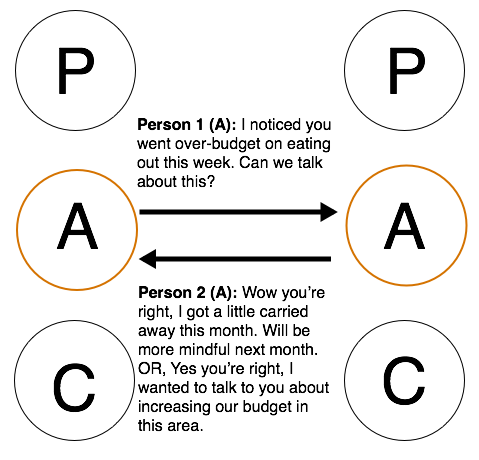
In this transaction, all is good:
- Person 1 is curious about something, and asks a question from the Adult ego state, hoping they’ll receive an answer from Person 2’s Adult ego state.
- Person 2 responds from his/her Adult ego state.
- Result: All good, two Adults are working together to understand a problem, make decisions, etc.
*I’m assuming that Person 1’s question is fueled by curiosity, thus coming from the Adult ego state. However, it could be that Person 1’s question is actually fueled by a desire to blame or prove a point. In this case, Person 1’s ‘Parent’ ego state is probably being activated, not the Adult.
Either way, the point of transactional analysis is to pay attention to your conversations with the people closest to you. To bring awareness to what roles (ego states) you’re both activating and why.
Example #2: Parent - Child
Another complementary transaction is Parent -> Child. For example, this can occur when one person is sick and wants to be taken care of by the other person (P).

- Person 1 feels like shit. Their Child ego state is activated because they want to be taken care of. They expect Person 2 to respond as a Parent.
- Person 2 understands Persons 1’s request and is happy to oblige. Person 2’s Parent ego state is activated and they happily take care of Person 1.
- Result: All is good. There’s a balance of ‘giving & receiving’ and both parties feel loved.
How do you know you’re having a complementary transaction?
- You feel ok (i.e. you’re not overwhelmed with emotions)
- You feel seen and understood
- The conversation can go on forever (no emotional outbursts, hurt feelings, slamming doors, or conversation stoppers — i.e. “I’m done with this conversation right now”). This means you can actually reason about things, make decisions, create a plan, etc.
Crossed Transactions
Crossed transactions happen when Person 1 says something from one ego state, and receives a different response than he/she is expecting.
For example: Back to the money topic.
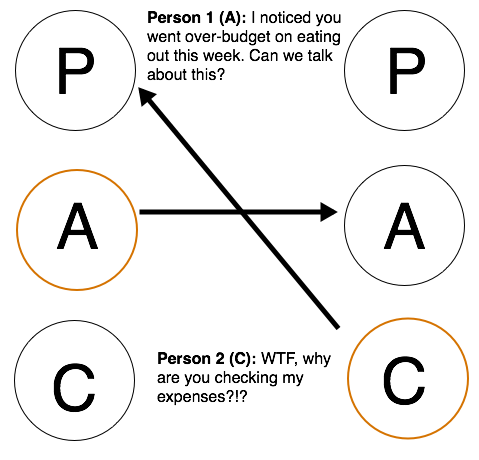
In this transaction, all is NOT good:
- Person 1 is curious about something, and asks a question from the Adult ego state, hoping they’ll receive an answer from Person 2’s Adult ego state.
- Person 2 is triggered. They’re Child ego state is activated (they feel criticized or patronize) and they’re pissed.
- Result: Probably a fight, or an abrupt end to the conversation. Of course it’s ok if this happens once in a while, however habitual communication breakdown is harmful to a relationship.
Another example is:
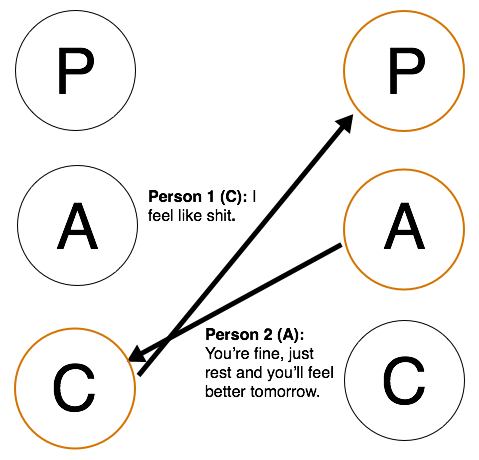
- Person 1 feels like shit. Their Child ego state is activated because they want to be taken care of. They expect Person 2 to respond as a Parent.
- Person 2 hears Persons 1, but doesn’t see what the big deal is. His/her Adult ego state is activated and they tell Person 1 to rest.
- Result: Person 1 probably feels hurt because his/her needs weren’t being met. *Again, crossed transactions happen all the time. TA is about bringing awareness to these transactions so we can reduce their negative effect.
According to TA, all communication breakdowns occur because of a crossed transaction.
When you’re in the middle of a crossed transaction, the only way to get it back to a constructive place is for one, or both of you, to shift ego states.
Usually, it’s best to shift (or try very very hard to shift) to the Adult ego state. However, it can vary. You need to be attuned to what’s actually happening in a conversation and the needs of each person (hard to do, but possible with practice).
Now what?
TA is a great tool to help you have better, more constructive conversations with the people closest to you. It can help you:
- Be more aware of what the other person needs (does your friend need you to be a Parent (and nurture) or an Adult (and give advice)?
- Analyze your relationship patterns, is one of you consistently activating his/her Child ego state? Do you like this pattern?
Ask yourself:
- What ego states are being activated in my transactions (by me AND my partner/friend/etc.?
- What ego state response am I (or the other person) expecting?
- What patterns do I see? Is one ego state constantly being activated? When/with who?
- Do I want this ego state to be activated like this?
In Part 2 I’ll explore Ulterior transactions and the games we play. Stay tuned:)
References
- Games People Play by Eric Berne
- I’m Ok, You’re Ok by Thomas A. Harris